
Coupon API · Developer product
One coupon API. Every network you already run.
Feedico is the coupon API and coupon feed API publishers use for live codes, titles, eligibility windows, and merchant context, across CJ, Awin, Impact, and more. One bearer token. One JSON contract. Your network approvals stay yours.
Built for publisher stacks
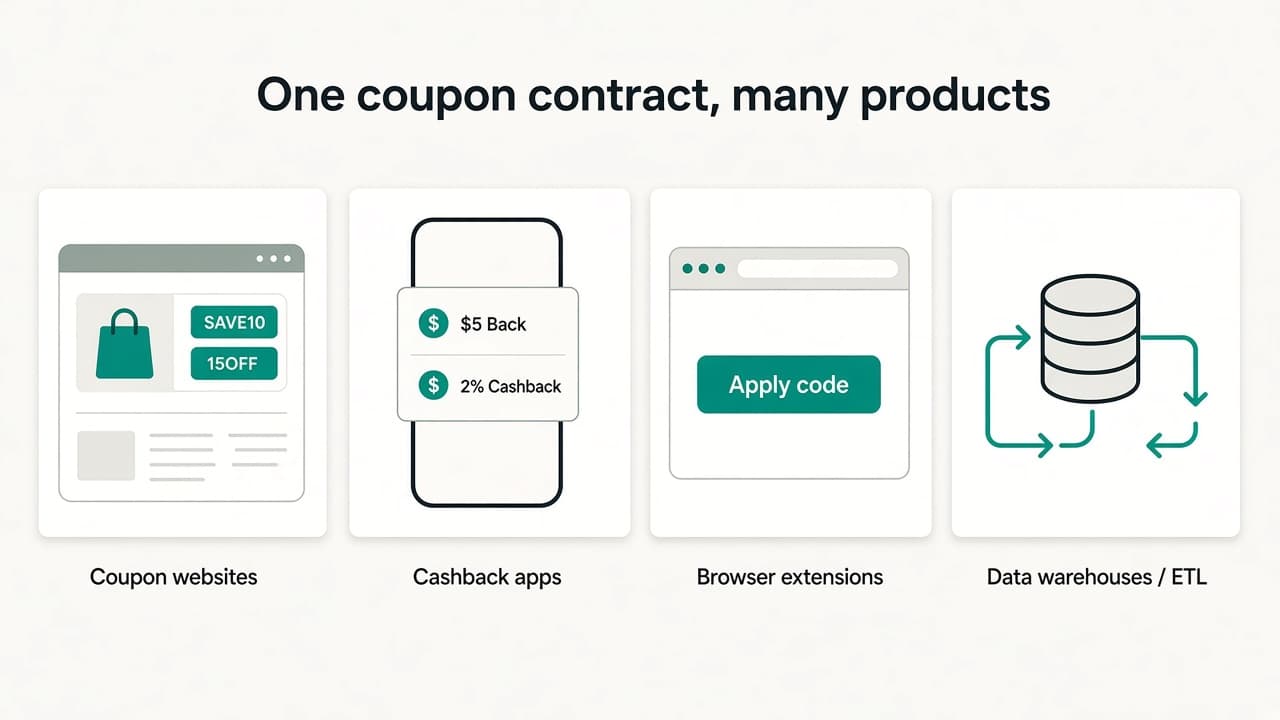
Answer “is this built for my stack?” before you open OpenAPI. Same coupon contract powers deal sites, cashback, extensions, and warehouse ingest.
From API rows to product UI
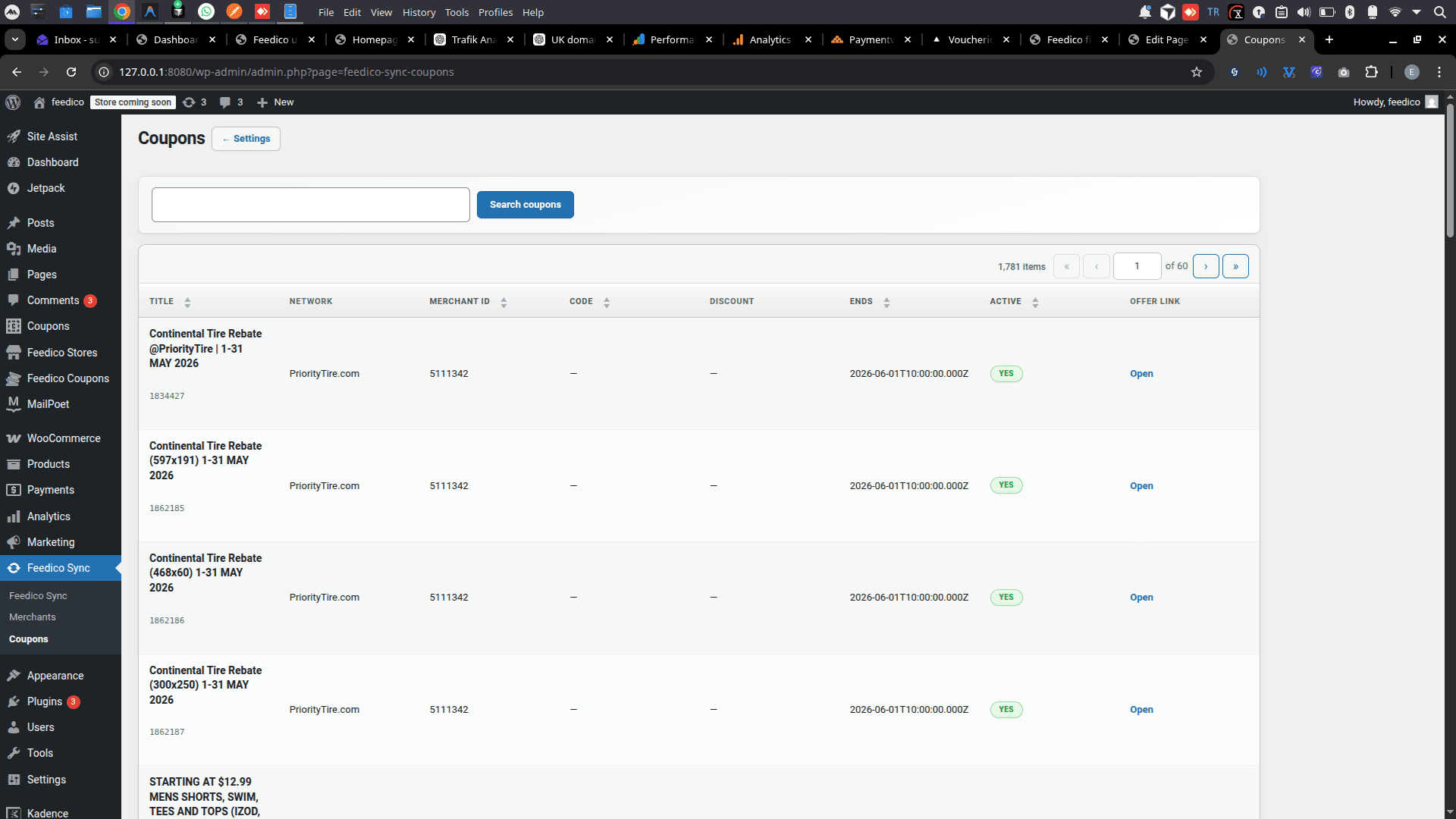
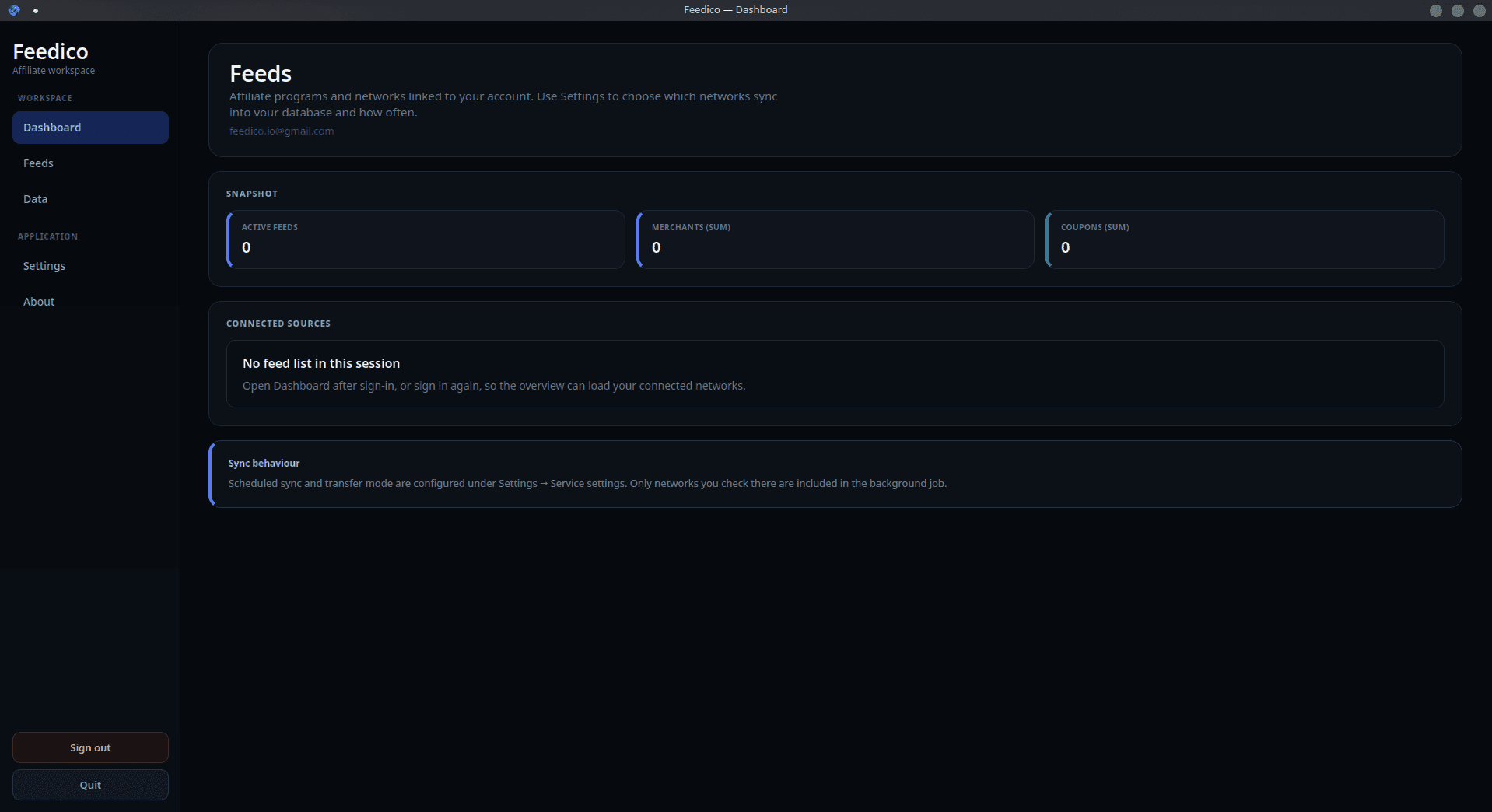
Normalized coupon rows are what editors and engineers already work with in Feedico products: WordPress sync tables, local feeds, and public brand pages.
Supported networks
Connect credentials in the dashboard for the sources your account is approved for. Icons are vendor favicons for quick recognition; logo marks are trademarks of their owners.
Built for coupon UX
Search pages, browser extensions, email digests, and in-app “apply code” flows need structured data, not HTML scrapers. List coupons with POST bodies (including merchant name fragments), page through results, and read provider when auditors ask where a row originated. Pair with the CJ API landing when a single network dominates acquisition. Preview sample coverage on the live coupon feed; pair catalogue + promotions via the affiliate API; check pricing for quotas. Searching couponapi? See the CouponAPI note below.
How it works
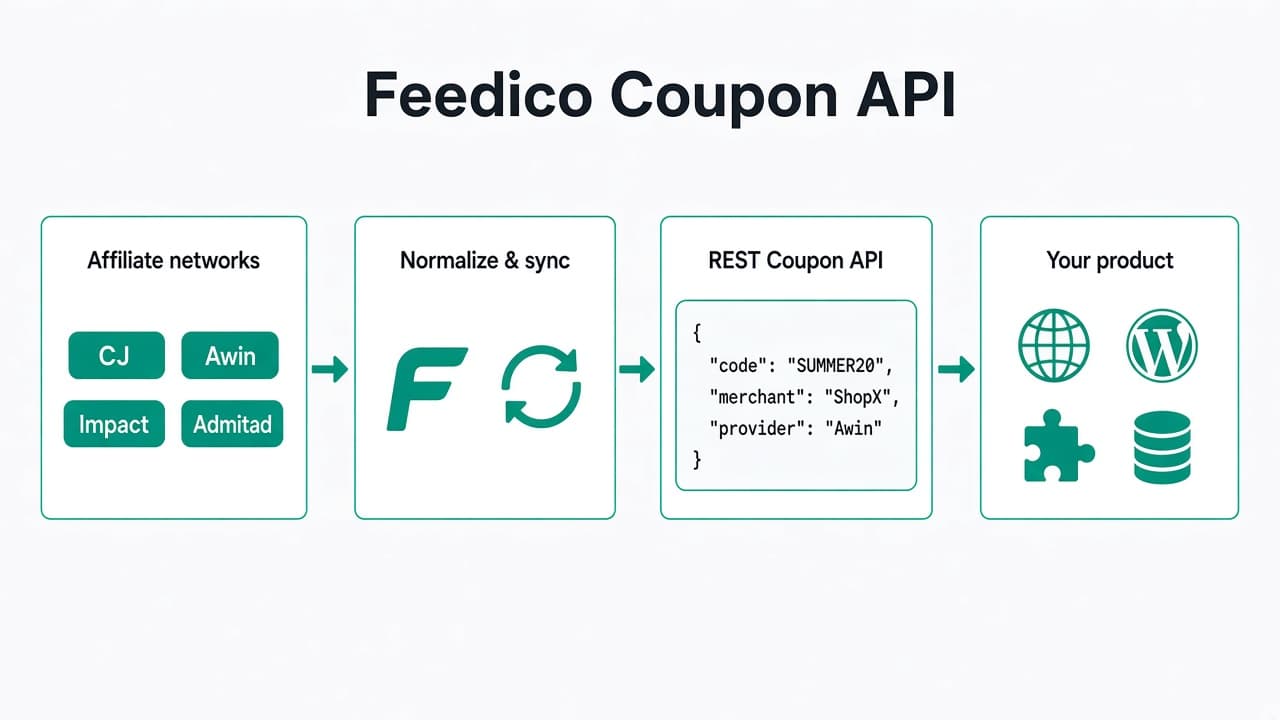
Networks → Feedico normalization → REST API → your product. Subsystems you actually operate with are called out, so engineers know where pagination, caching, and sync fit.
- 1
Affiliate networks
CJ, Awin, Impact, Partnerize, Admitad, TradeTracker, Takeads, Take Deals: your live credentials and programme approvals.
- 2
Normalization & sync
Feedico maps upstream feeds into firm + coupon tables on a plan-aware cadence.
Sync jobsDashboard visibilityWebhooks (eligible plans) - 3
REST API
Versioned HTTPS JSON: Bearer token auth, predictable envelopes.
PaginationRate limitsPOST filters - 4
Your app
Website, mobile, extension, BI export: your caching policy on top.
CDN / edge cacheETag-friendly pollingIdempotent upserts
Real business benefits
Ship integrations faster
One client to code-review, not five snowflakes.
Reduce maintenance cost
Upstream drift is contained in Feedico, not every microservice.
Normalize affiliate data
Same fields for coupon rows across connected providers.
One auth model
Bearer token for your servers; rotate in one place.
Easier scaling
Add a network connection; your consumer JSON stays stable.
Performance, scale & operations
API buyers care about predictable cost curves. Feedico exposes list endpoints with explicit pagination, documented pageSize caps, and plan-based monthly successful-call quotas so you can model spend. Sync frequency ties to your tier: fresher data when your UX demands it. Where enabled, webhooks reduce pure polling pressure; your edge cache still controls tail latency for public readers.
Example coupon payload
Illustrative JSON - field names align with our customer OpenAPI (provider, networkName, offerUrl, etc.). network below is a human label for the reader; responses use provider (cj_affiliate, …).
{
  "network": "CJ",
  "provider": "cj_affiliate",
  "merchant": "Nike",
  "networkName": "Nike US",
  "title": "10% off orders",
  "code": "SAVE10",
  "startsAt": "2026-05-01T00:00:00.000Z",
  "expiresAt": "2026-06-01T23:59:59.000Z",
  "offerUrl": "https://…"
}
Feedico vs manual integrations
| Topic | Feedico | Manual per-network |
|---|---|---|
| One auth | ✅ API bearer token | ❌ Many secrets & rotations |
| Unified schema | ✅ Shared coupon envelope | ❌ N schemas to map |
| One API surface | ✅ Same list contract | ❌ Parallel clients |
| Maintenance overhead | Low - drift isolated | High - every changelog |
| Operational visibility | Dashboard + sync signals | Mostly DIY logging |
See also: full Feedico vs manual integrations.
Why now?
Individual affiliate APIs do not scale as a strategy: every new network introduces different schemas, auth flows, pagination, and ops overhead. Teams that “just” add one more programme discover integration tax compounding - shipping product slows while nursing fragile clients. Feedico exists to compress that tax: keep your network relationships, delegate normalization + delivery, and get back to conversion UX.
CouponAPI / couponapi searches
Queries like couponapi and CouponAPIusually mean “one HTTP API for promo codes.” Feedico is that surface for your approved affiliate programmes, not a black-box public coupon dump. Connect networks in the dashboard, call list endpoints with a bearer token, and keep provenance per row. Architecture comparison: Feedico vs CouponAPI. Try sample rows on the live coupon feed before production keys.
Global coupon catalog: discovery without connecting a network
Besides your account-scoped lists, two catalogue endpoints expose the global Feedico database: merchants merged by display name across all synced tenants, and coded promos deduplicated by brand + code. Use them to research coverage, seed directories, or decide which programmes to join. Catalogue rows never include offerUrlor other publishers' tracking links; production clicks still come from your own connected networks or Managed Partner.
POST /api/v1/catalog/networksUnique merchant display names;
providers[]lists every upstream source.POST /api/v1/catalog/couponsPromo codes with a non-empty code, deduplicated by brand + code. Discovery only.
curl -s https://api.feedico.io/api/v1/catalog/coupons \
  -H "Authorization: Bearer fdco_YOUR_TOKEN" \
  -H "Content-Type: application/json" \
  -d '{"page":1,"pageSize":50,"firmName":"Banggood"}'
Coupon feed API: warehouses and batch jobs
A coupon feed is not a separate product. Page through list endpoints on a schedule, persist slices, and diff locally. Cron workers, Airflow tasks, and lake ingest all share the same bearer token and field model as your production app. Complementary outbound delivery on eligible plans may reduce pure polling; you still own tail latency and backoff when bursts hit. For a full engineering walkthrough (schema, Python worker, webhooks), read how to build a coupon warehouse with Feedico ETL. WordPress-only stacks should start with import CJ coupons to WordPress.
Deal feed API: carousels and commerce modules
Another common split is “deal feed API” vs “coupon API”. Partner offers, flash promos, and voucher codes all land in the same normalized row your engineers already call. Merchandising teams wire homepage carousels, app tiles, and newsletter strips from that JSON so editors stop pasting static HTML. You remain responsible for disclosures, programme rules, and outbound tracking parameters.
Webhooks & push invalidation
On eligible plans, Feedico can notify your endpoints when sync completes or when coupon rows change, reducing blind polling against list APIs. Configure webhook URLs in the dashboard; your workers still own retries, signature verification, and cache invalidation. For warehouse-scale mirrors, pair webhooks with the coupon warehouse ETL guide.
Frequently asked questions
- What is a coupon API?
- A coupon API returns promo codes, titles, eligibility windows, and merchant context as structured JSON over HTTPS. Feedico's coupon API normalizes rows from CJ, Awin, Impact, and other networks into one listing contract for apps, sites, and ETL pipelines.
- What is a unified coupon API?
- A unified coupon API is a multi-network coupon listing contract: one bearer token, one JSON shape, and promo codes from every affiliate programme you connect. Feedico's /coupon-api endpoints are that unified coupon API; /unified-affiliate-api is the broader pillar for merchants, programmes, and coupons together.
- Is Feedico a CouponAPI / couponapi alternative?
- Teams searching couponapi or CouponAPI often want a single HTTP surface for codes. Feedico is a bring-your-own-network coupon API: you connect approved CJ, Awin, Impact (and other) credentials; we normalize and deliver. Compare philosophies on Feedico vs CouponAPI.
- What is a coupon feed API?
- A coupon feed API is the same listing contract used as a scheduled feed: page through coupons, persist slices, and refresh warehouses or CMS caches. Feedico's coupon feed API is not a separate product URL: it is the coupon list endpoints plus optional webhooks.
- What are affiliate coupon feeds?
- Affiliate coupon feeds are continuously refreshed streams of promo codes and voucher metadata from connected affiliate programmes. Feedico exposes them through list endpoints and a public live coupon feed sandbox so publishers can preview coverage before production coupon API integration.
- What are coupon integrations?
- Coupon integrations are the engineering patterns that wire a coupon API into WordPress, cashback apps, browser extensions, or data warehouses. Feedico supports coupon integrations through one bearer token: server-side fetch, pagination, and normalized fields, instead of bespoke clients per network.
- Do I still need affiliate approval?
- Yes. Feedico does not replace enrolment or compliance at each network. You connect your own credentials and must stay approved for the programmes you promote. Feedico normalizes and delivers data - it does not grant access to merchants you have not legitimately joined.
- Does Feedico host affiliate links?
- Feedico stores and serves normalized coupon and programme metadata (for example offer URLs returned by your connected integrations). You remain responsible for outbound tracking links, disclosures, and how click traffic is attributed in line with each network's policies and your own site terms.
- How are quotas handled?
- Customer API usage is metered: successful calls to account-scoped list endpoints count against your plan's monthly quota (UTC calendar month). When limits are exceeded, the API returns a documented error so you can backoff, cache, or upgrade. Exact numbers are shown in plan copy and documentation.
- Can I use multiple networks together?
- Yes. Connect multiple sources in the dashboard; responses can include rows from every connected provider. Filters such as provider and availableProviders metadata let you segment or combine networks in one integration.
- Does Feedico normalize coupon fields?
- Yes. Upstream networks use different shapes and field names; Feedico maps them into a consistent coupon listing model (titles, codes, windows, merchant keys, offer URLs, provider identity, etc.) so your application code stays stable.
- Is the HTTPS listing different for ETL than for a customer-facing app?
- No. Product UX, cron workers, warehouse loaders, and cache warmers all call the same account-scoped list contract. Use documented pagination until a page is empty, then store deltas in your own database. Plans still meter successful list calls per UTC month.
- Can editors reuse the same rows for deals, carousels, or hero modules?
- Yes. Flash promos, partner offers, and code-based savings map into the same normalized coupon model. Merchandising is mostly how you frame content in CMS or mobile UI; you do not need a second integration for deal strips if you already consume coupon lists.
Network-specific guides
Volume often clusters on a flagship source. Each network has its own guide; this page stays the unified contract reference: CJ API, Awin API, Impact API, Admitad API, TradeTracker API, Partnerize API, and Takeads API.
Affiliate disclosure: some links on Feedico are affiliate links. We may earn a commission when you buy through them, at no extra cost to you. Publishers still need programme approval and compliant use at each affiliate network. Feedico provides the integration layer, not a substitute for network terms.
Related pages
- Managed Partner (ready catalog)
- Affiliate coupon feeds (sandbox)
- Affiliate API / marketing API
- Pricing
- Feedico vs CouponAPI
- Product deal feed API (sale SKUs)
- Coupon integrations (WordPress)
- Coupon marketplace websites
- Browser extensions
- CJ API
- Awin API
- Impact API
- Admitad API
- TradeTracker API
- Partnerize API
- Takeads API
- Unified affiliate API
- ETL & coupon feeds
- Deal & merchandising feeds