
Linux · Affiliate data sync · Coupon warehouse · v0.1.0
Self-hosted affiliate & coupon database client for Linux
Most affiliate tools lock merchant and coupon intelligence in a hosted UI. Feedico still ships a production coupon API, but this desktop app adds something rarer: a local affiliate ETL that mirrors normalized programs - CJ Affiliate, Awin, Impact, TradeTracker, Partnerize, Admitad, and more - into your SQLite or MySQL environment (a true local merchant database).
Think of it as affiliate aggregator plumbing you run on-premises: scheduled sync (systemd), manual refresh, merchant + coupon explorer, and CSV extracts - beside the same account you would use for REST integrations or the WordPress coupon sync plugin.
Direct downloads: https://feedico.io/downloads/feedico-client_0.1.0_all.for-debian-and-ubuntu.deb · https://feedico.io/downloads/feedico-client-0.1.0.linux-universal-portable.tar.gz
Built for affiliate publishers
Pipelines, coupons, and merchant metadata - not generic file sync.
Self-hosted capable
Keep a durable local mirror alongside (or instead of) ad-hoc API pulls.
API-first architecture
Same normalized model as the hosted coupon API and automation hooks.
Example use cases
Long-tail editorial and internal-tooling queries cluster around these jobs - they reinforce why a local coupon database matters next to a public affiliate API.
Build a local coupon warehouse
Accumulate historical offers, spot expirations, and compare discount depth without re-querying every network adapter by hand.
Prepare datasets before WordPress publish
Validate merchants and codes locally, then push through the Feedico → WordPress path when editorial is ready.
Run affiliate analytics offline
Point BI tools at MySQL or export slices to CSV for notebooks - fewer round trips to hosted dashboards.
Internal reporting & compliance
Maintain an auditable mirror of which programs and coupons you exposed on a given date.
ETL hand-off to custom stacks
Treat Feedico as the normalization layer, then pipe rows into your warehouse or pricing engines.
Power-user editorial workflow
Search coupon text fast, filter by network metadata, and share snapshots with non-technical teammates.
Architecture at a glance
Cloud plane: Feedico ingests partner APIs, applies rate-limit friendly sync, and exposes a bearer-token affiliate JSON API for coupons, merchants, and network entities.
Desktop plane:The Linux client authenticates to your workspace, downloads normalized rows, and applies them to a configured target - an "affiliate ETL" step you own. Scheduled mode uses systemd user units; manual mode replays the same transforms on demand.
Compared to cloud-only aggregators: you trade zero-install convenience for data locality - backups, custom indexes, proprietary joins, and air-gapped analysis become realistic.
Capabilities
Affiliate feed cockpit
Dashboard, feeds, and structured data views tuned to publishers managing many programs.
Database choice
SQLite files for simplicity; MariaDB / MySQL-compatible servers for shared analytics.
Coupon warehouse tooling
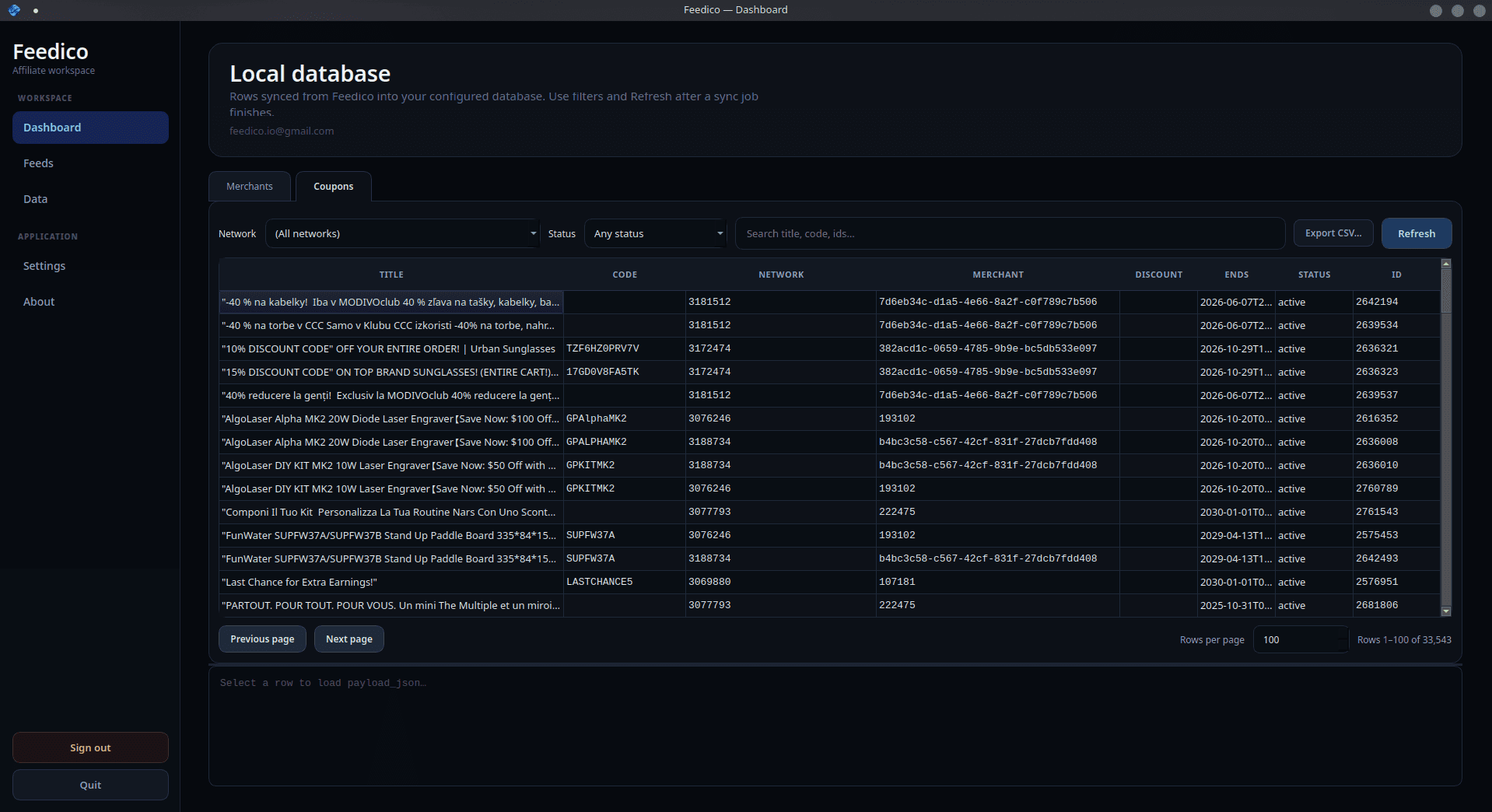
Filters, pagination, keyword search, and CSV export for merchant and coupon tables.
Automation friendly
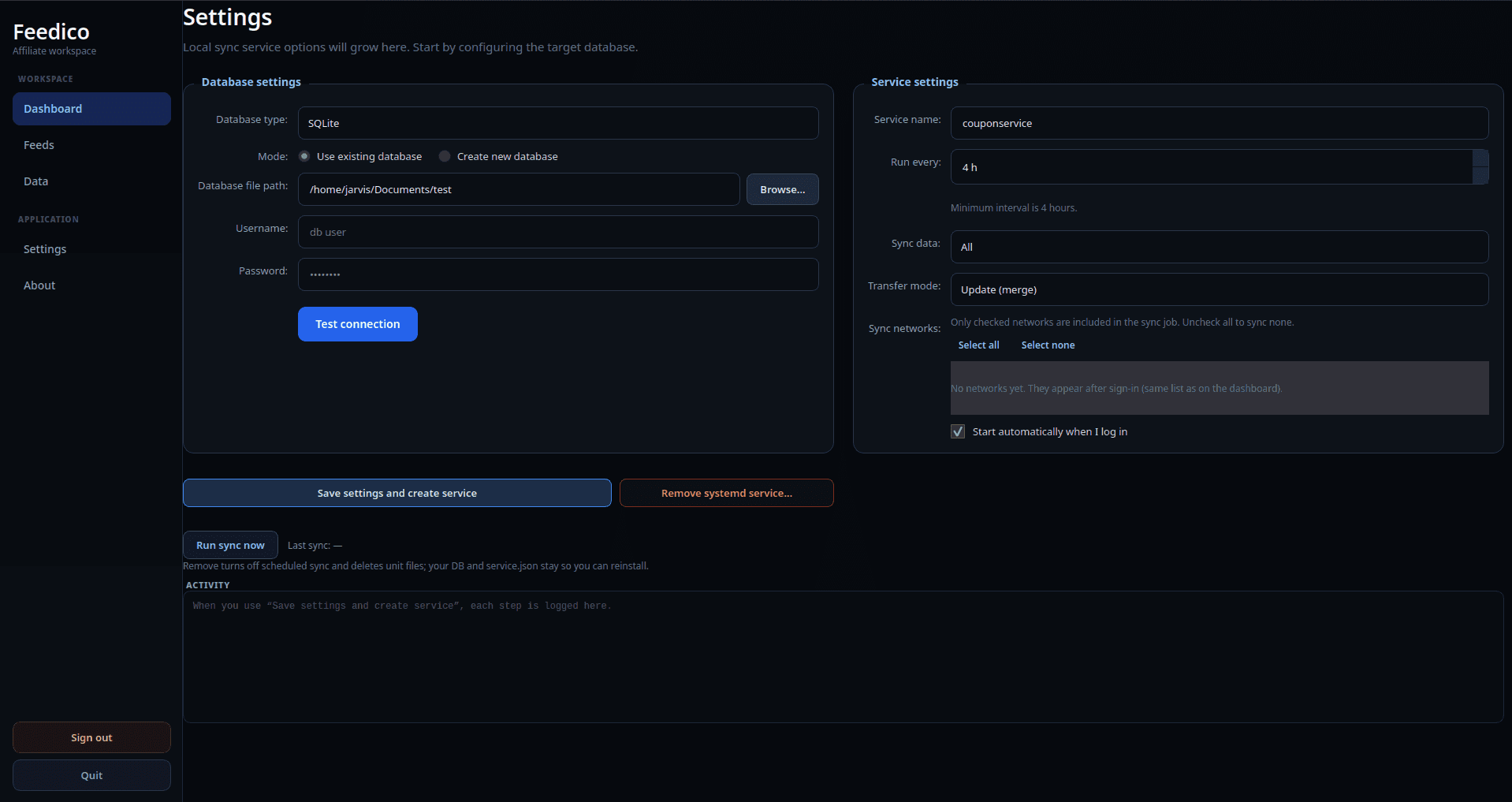
Timers, service units, and logs align with how operators run production cron-style workloads.
Network breadth
Designed for the same multi-network roster you see on feedico.io - not a single-program toy client.
Portable install story
.deb for Debian derivatives; tarball for Fedora, Arch, or air-gapped staging with documented dependency steps.
Interface tour
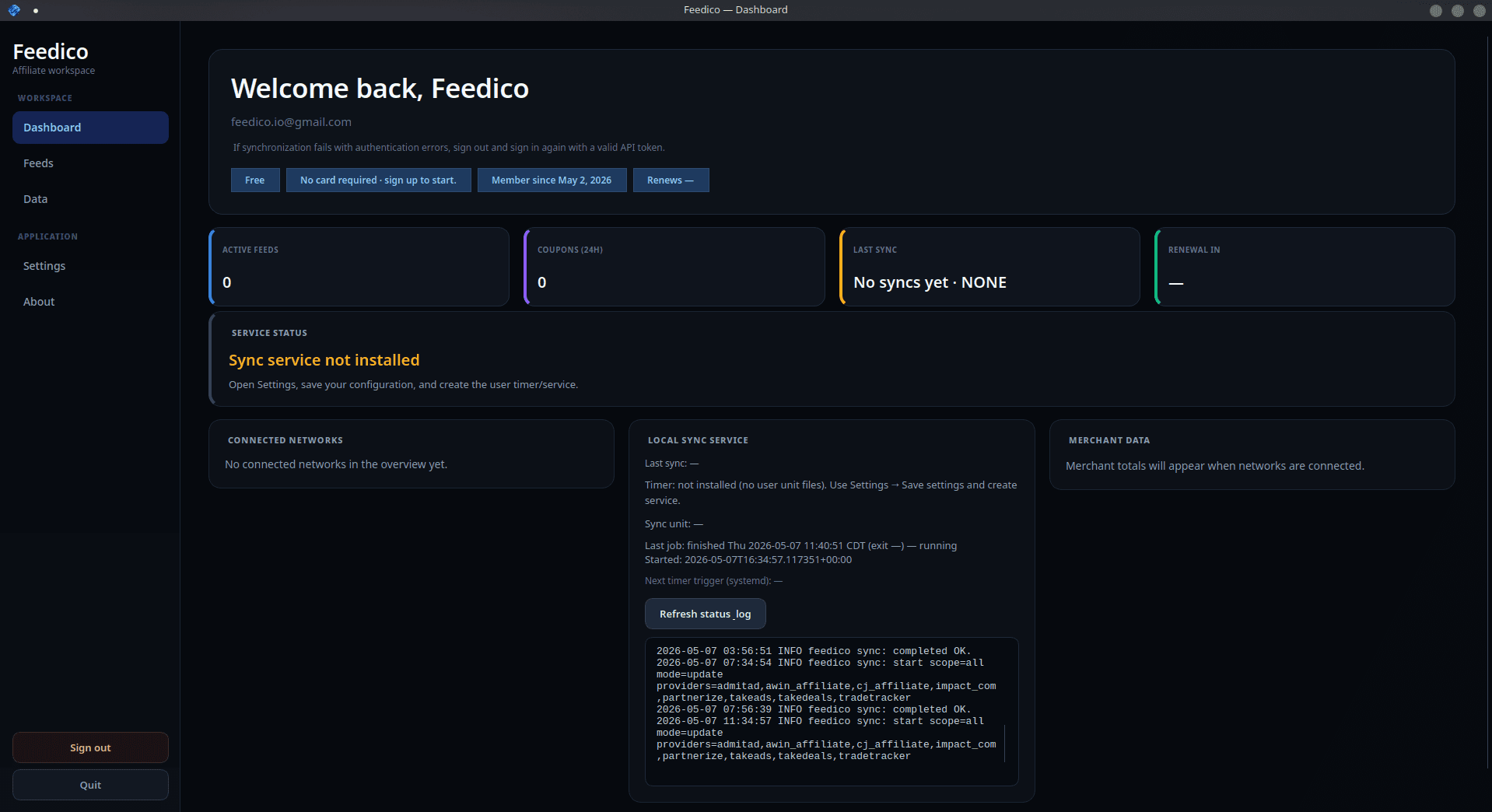
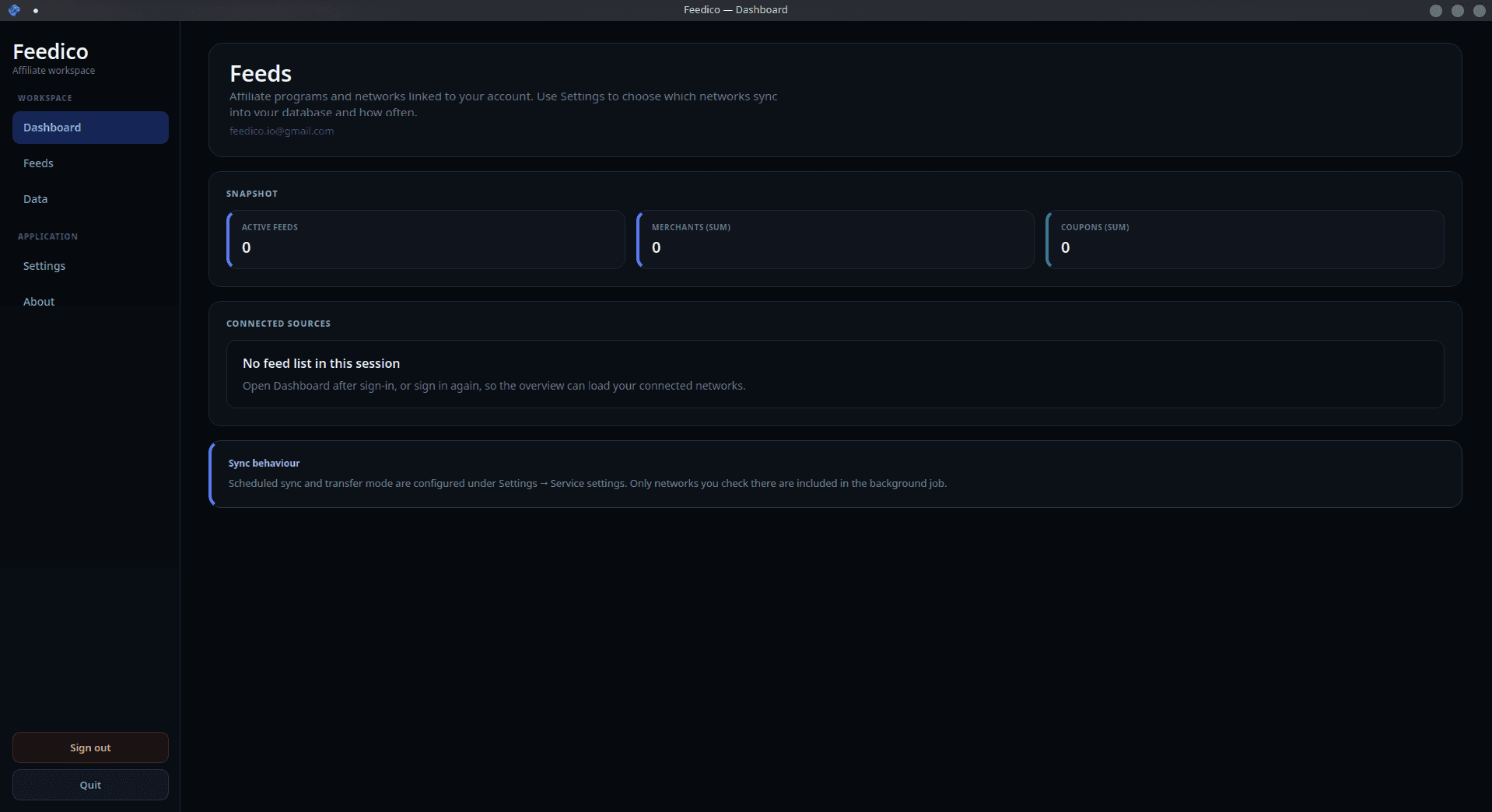
Descriptive captures from the Linux affiliate sync client - each block pairs imagery with keyword-rich context for readers (and crawlers) mapping UI affordances to outcomes.
Affiliate dashboard & sync telemetry
Network feeds & programs
Local coupon & merchant database
Sync service & database target
Install & requirements
Platform requirements
- Debian 12+ or Ubuntu 22.04+ for the tested .deb path
- Other distros via portable tarball + documented Python stack
- Python 3.10+ (package metadata) - 3.11+ recommended for long-running PyQt workloads
- Optional: systemd (user session) for background timers
Supported local databases
- SQLite - single file, minimal ops
- MySQL / MariaDB - team analytics, replication, BI connectors
Sync & export modes
- Manual sync (“run now”) for ad-hoc affiliate data refresh
- Scheduled background sync via systemd user service + timer
- Transfer modes: merge / update-style jobs (configure in-app) to avoid blowing away historical analysis tables unintentionally
- Export formats: CSV today; JSON dumps pair naturally with the hosted API for custom relays
Option A - Debian / Ubuntu (.deb)
Dependencies enforced by the package manager: python3 (>= 3.10), python3-pyqt6, python3-pymysql, python3-keyring. Install with sudo apt install ./feedico-client_*_all.for-debian-and-ubuntu.deb, then launch the desktop entry.
Option B - Portable archive
Install distro-equivalent packages (see INSTALL-PORTABLE.txt), extract, run ./run.sh, or use the system install helper for a global tree.
Explore the Feedico cluster
Internal linking helps search engines understand how this Linux affiliate sync client sits beside the rest of the product surface.
Topics teams research alongside this product
These tutorial-style questions sit adjacent to the Linux client and help teams researching affiliate data sync, coupon warehouse design, and self-hosted affiliate feeds find topical answers - several already map to sections on the homepage.
- How to build a local coupon database from network programs
- Self-hosting affiliate network feeds next to a public coupon API
- SQLite vs MySQL / MariaDB for affiliate publisher warehouses
- Running affiliate analytics locally after a scheduled sync
- How to mirror multi-network coupon APIs with minimal glue code
Frequently asked questions
Does Feedico store affiliate data locally?Show answerHide
Yes, when you use this Linux desktop client: it synchronizes normalized merchants and coupons from your Feedico account into a database file or server you control (SQLite or MySQL-compatible). The cloud Feedico product remains API-first; the client adds a local affiliate ETL / mirror option.
Which affiliate networks are supported?Show answerHide
Support follows your Feedico account: publishers connect programs such as CJ Affiliate (Commission Junction), Awin, Impact, Partnerize, TradeTracker, Admitad, Takeads, Takedeals, and others in the dashboard. The desktop client syncs whatever networks your subscription and integrations authorize - it is an affiliate aggregator-style pipe into your own coupon warehouse.
Can I use SQLite instead of MySQL?Show answerHide
Yes. Pick SQLite for a single-file local coupon database on disk, or point the client at MariaDB / MySQL when you need multi-user access, larger analytical workloads, or BI tooling.
Does Feedico work offline?Show answerHide
Synced merchant and coupon rows live locally, so browsing, filtering, and CSV export work without an active browser session. Fresh incremental sync still requires network reachability to Feedico APIs - think offline read, online refresh.
Can I export merchant and coupon data to CSV?Show answerHide
Yes. After a sync completes, use the data views to export merchants or coupons to CSV for spreadsheets, editorial prep, or downstream pipelines.
Does Feedico support scheduled sync?Show answerHide
Yes. On Linux the app can create a systemd user service and timer (for example every four hours) so affiliate sync software runs in the background without manual triggers.
Is Feedico available for Windows?Show answerHide
This Debian/Ubuntu package and portable archive target Linux. A macOS .dmg is also available from the Product page. Windows desktop builds remain on the roadmap alongside the REST coupon API and WordPress plugin.
Can I self-host affiliate feed data?Show answerHide
In the sense of owning a durable local mirror: yes - the client is built for self-hosted affiliate data (coupon database + merchant tables) that you backup and query on your terms, complementary to cloud-only dashboards.
Does Feedico include coupon APIs?Show answerHide
Yes. Feedico exposes a versioned REST API for merchants and coupons; the Linux client is a desktop affiliate API client experience layered on the same normalized model.
Can I sync CJ Affiliate coupons locally?Show answerHide
When your Feedico workspace is connected to CJ and related programs, sync jobs can pull those offers into your local database - subject to plan limits and network authorization.
Ready to own your affiliate rows?
Pair the Linux desktop mirror with the hosted API for hybrid architectures - edge editorial on the desktop, automation via REST, publishing through WordPress when you need front-end velocity.